Learn more about Autonomo here.
Prerequisites
The user installing the Autonomo application must be assigned as an admin, manager or install role.
Before starting, please review the install check list in the first section.
There are three ways you can install Autonomo:
- Autonomo 4 - Installation via UI
- Autonomo 4 - Installation via command line (quiet install) - This document.
- Autonomo 4 - Intune setup info
Please see the below to find more details when installing Autonomo:
- Autonomo - Asset Category and Asset Sub-Category options
- Autonomo - Asset Groups
- Autonomo - Auto-provisioning
- Autonomo 4 - Install Troubleshooting Guide
Steps for Installing Autonomo on an Asset
- Create an account in the Troverlo Portal if one does not exist for your company.
- Download Autonomo
- Autonomo, by default is put into the downloads folder.
Interactive UI install/update of Autonomo
- Launch TroverloAutonomoV<x.y.z>.msi
- <x.y.z> is the version number for example TroverloAutonomoV4.3.6.msi.
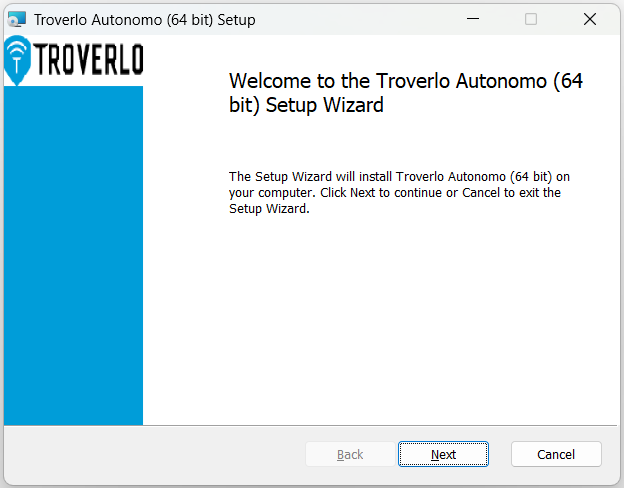
- Press next
- Enter your Trovelro user credentials here.
- Please note: the user that is installing Autonomo must have the "installer" role assigned to them. - see User (Team Member) Management
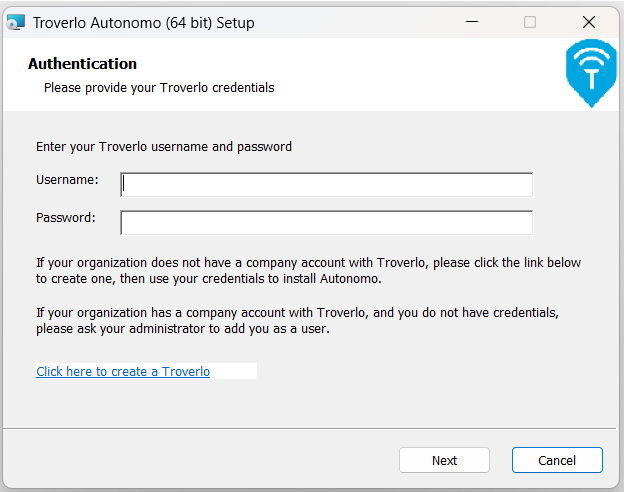
- Click "next"
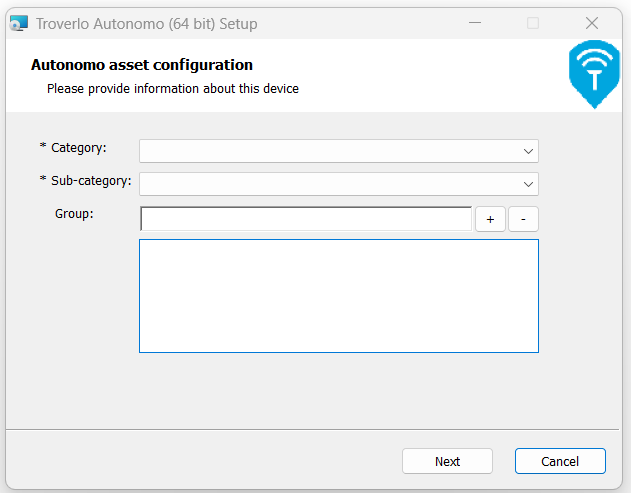
- Required:
- Select a Category.
- Select a Sub-category.
- See Autonomo - Asset Category and Asset Sub-Category options for more info.
- Optional
- Asset Group
- Enter the name of a Group in the textbox and click the “+” button.
- If you enter a group that doesn’t currently exist, it will be created
- To remove a group, click on the item in the list and then click on the “-” button.
- See Autonomo - Asset Groups for more info on why to use Asset Groups.
- Asset Group
- Click “Next”
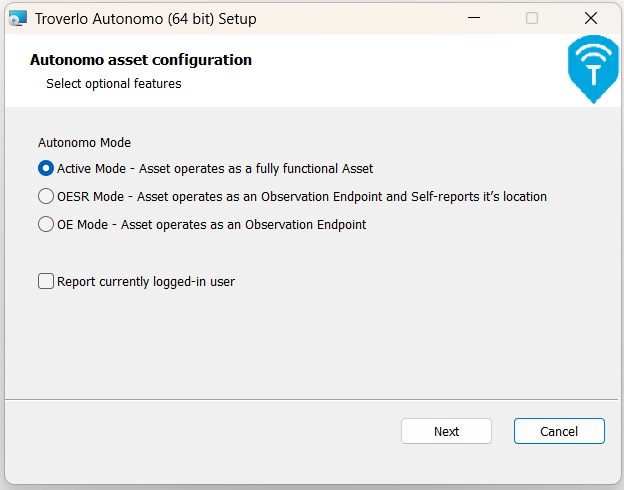
- Required - Select an Autonomo Mode.
- “Active”
- Autonomo operates as an Observation Endpoint and there is a desire to track this device as an Asset.
- Autonomo will post Wi-Fi scan data for all detected APs and other Troverlo Assets (if any) within an observation window and will include its own ID in the post.
- Can publish or receive Action Commands.
- This is the default.
- “OESR” – Observation Endpoint Self-reporting
- Autonomo operates as an Observation Endpoint and there is a desire to track this device as an Asset.
- Autonomo in this mode will ONLY post Wi-Fi scan data about itself, Assets and APs when other Troverlo Assets are detected within an observation window.
- Never advertises its location – when offline it doesn’t beacon.
- Can publish, but cannot receive Action Commands.
- “OE” – Observation Endpoint
- Autonomo operates as an Observation Endpoint and there is NOT a desire to track this device as an Asset.
- Autonomo in this mode will ONLY post Wi-Fi scan data that contains Troverlo Assets and APs when other Troverlo Assets are detected within an observation window.
- Never advertises its location – when offline it doesn’t beacon.
- Can publish, but cannot receive Action Commands.
- “Active”
- Optional - Select "Report currently logged-in user" to receive the current user with each observation for that Asset.
- WARNING: You canNOT use "Report currently logged-in user" with OE Autonomo mode. If you select this combination, you will see this error.
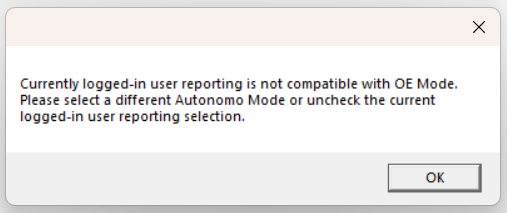
- Once you have address this, you can move forward.
-
Select “next”
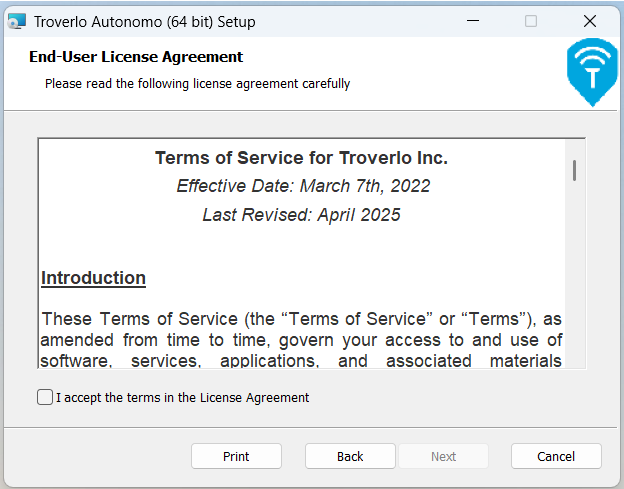
- Please scroll and read the Troverlo Terms of Service Agreement, and then select “I accept..” on the EULA.
- Select "Next."
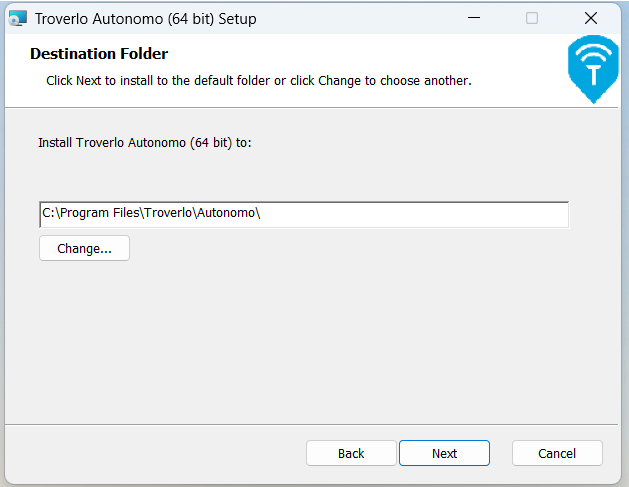
-
Select the Destination or use the default.
- Select "Next"
-
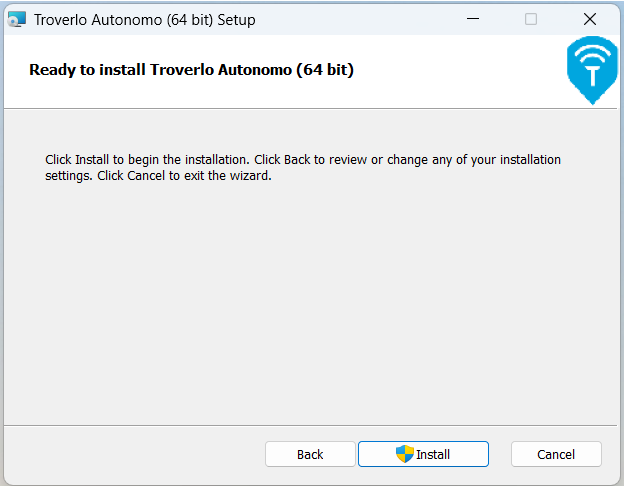
-
Select "Install" and it will start the installation.
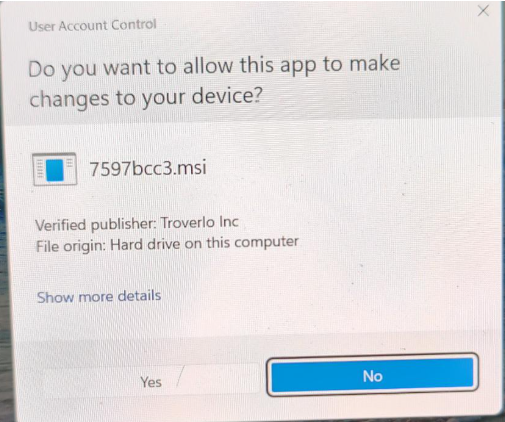
- If you see this, please select “yes” on this screen.
- This is showing progress of the installation.
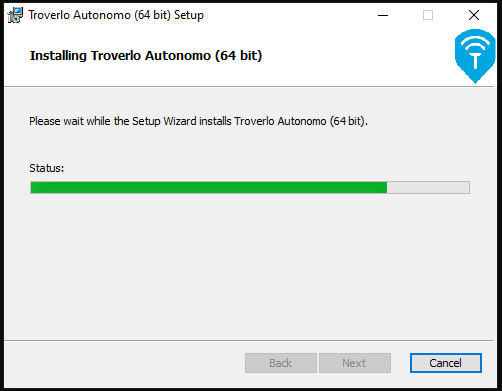
- if you need to stop the installation, select "Cancel."
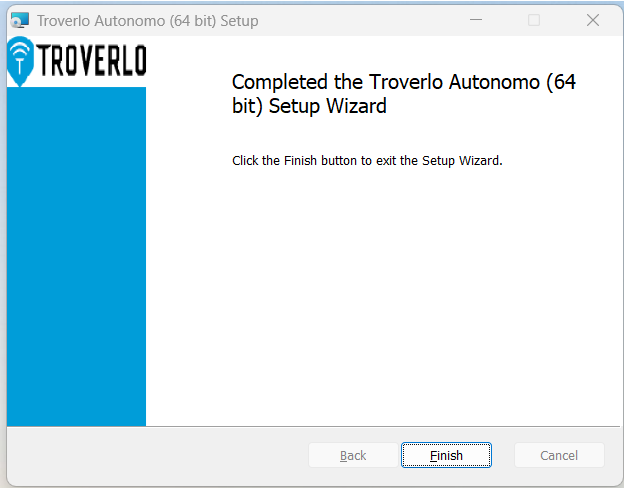
- Select “Finish”
- Now, all the Autonomo files will be installed, and it will Auto-provision itself on the Troverlo platform.
- About 2 minutes after the installation is complete, you should be operationally ready.
Steps for upgrading an existing Autonomo to a new release
- Download Autonomo
- This same link can be accessed by selecting the last option on the Navigation panel of the Portal.
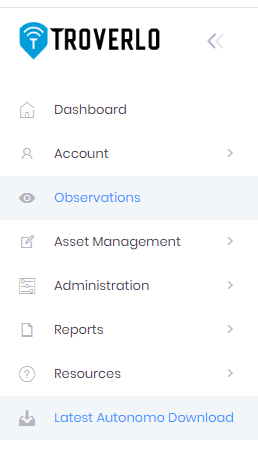
- This same link can be accessed by selecting the last option on the Navigation panel of the Portal.
- Launch TroverloAutonomoV<x.y.z>.msi.
- <x.y.z> is the version number for example TroverloAutonomoV4.3.6.msi.
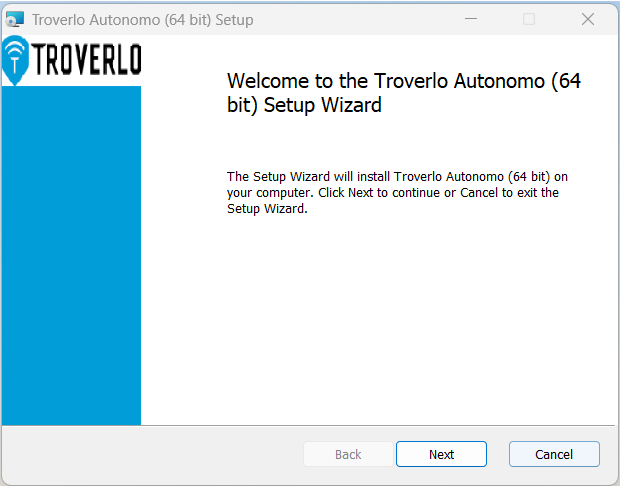
- Click “Next”
- Previous settings will be presented, you can accept those or you can change them at this time.
- Required - Select an Autonomo Mode.
- “Active”
-
Autonomo operates as an Observation Endpoint and there is a desire to track this device as an Asset.
-
Autonomo will post Wi-Fi scan data for all detected APs and other Troverlo Assets (if any) within an observation window and will include its own ID in the post.
-
Can publish or receive Action Commands.
- This is the default.
-
- “OESR” – Observation Endpoint Self-reporting
-
Autonomo operates as an Observation Endpoint and there is a desire to track this device as an Asset.
- Autonomo in this mode will ONLY post Wi-Fi scan data about itself, Assets and APs when other Troverlo Assets are detected within an observation window.
-
Never advertises its location – when offline it don’t beacon.
-
Can publish, but cannot receive Action Commands.
-
- “OE” – Observation Endpoint
- Autonomo operates as an Observation Endpoint and there is NOT a desire to track it.
- Autonomo in this mode will ONLY post Wi-Fi scan data that contains Troverlo Assets and APs when other Troverlo Assets are detected within an observation window.
-
Never advertises its location – when offline it don’t beacon.
-
Can publish, but cannot receive Action Commands.
- “Active”
- Optional - Select "Report currently logged-in user" to receive the current user with each observation for that Asset.
- WARNING: You cannot use "Report currently logged-in user" with OE Autonomo mode. If you select this combination, you will see this error.
- Once you have address this, you can move forward.
-
Select “next”
- Please scroll and read the Troverlo Terms of Service Agreement, and then select “I accept..” on the EULA.
- Select "Next."
-
Select the Destination or use the default.
- Select "Next"
-
-
Select "Install" and it will start the installation.
- This is showing progress of the installation.
- if you need to stop the installation, select "Cancel."
- Select “Finish”
- All the old files will be removed, all new Autonomo files will be installed, and it will Auto-provision itself on the Troverlo platform.
- About 2 minutes after the installation is complete, you should be operationally ready.
Steps for Repairing Autonomo
Launch TroverloAutonomoV<x.y.z>.msi- <x.y.z> is the version number for example TroverloAutonomoV4.3.6.msi.
- Select "Next"
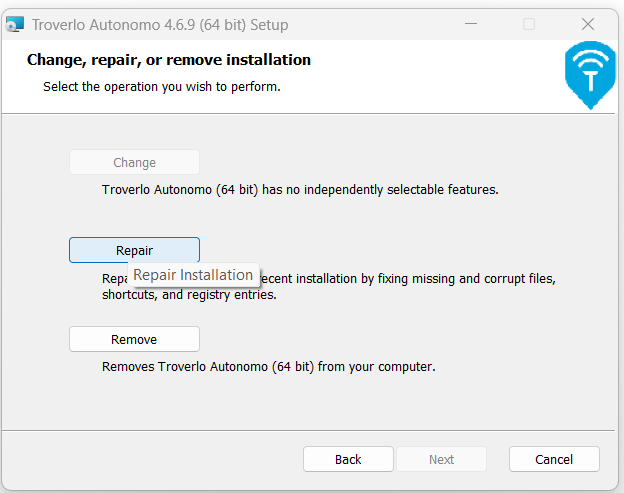
- Select "Repair"
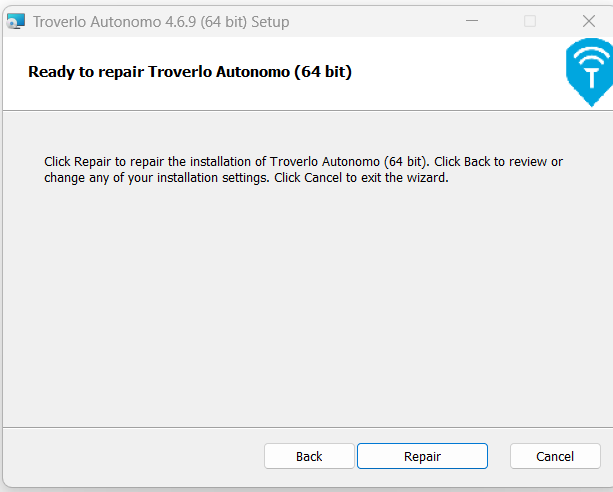
- Select "Repair"
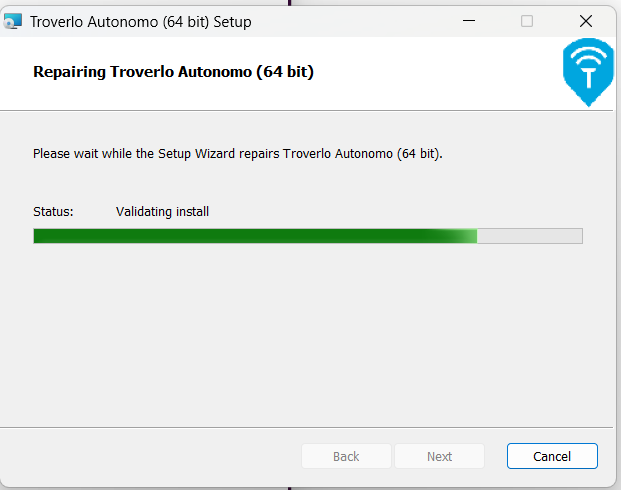
- It is restoring and replacing all files install previously.
- if you need to stop the installation, select "Cancel."
- Select “Finish”
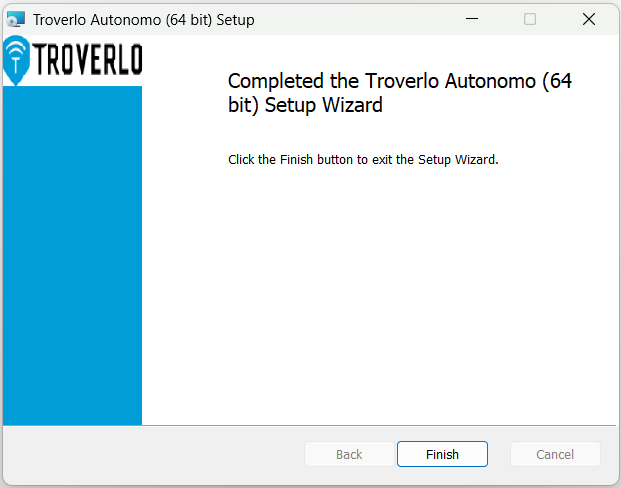
- Now, all the Autonomo files will be repaired, and it will Auto-provision itself on the Troverlo platform.
- About 2 minutes after the installation is complete, you should be operationally ready.
Steps for Uninstalling Autonomo
- To uninstall, the Asset must have internet connectivity and the User must have valid credentials to the Troverlo platform.
- With the 4.4.x to 4.5.x releases the Installer UI cannot uninstall Autonomo.
- Please see Autonomo 4 - Installation via command line (quiet install). and search for uninstall.
- With the 4.6 release and forward, any installer (UI or the quiet or Intune) can be used, as well as Add/Remove .
- Launch TroverloAutonomoV<x.y.z>.msi
- <x.y.z> is the version number for example TroverloAutonomoV4.3.6.msi.
- Select "Next"
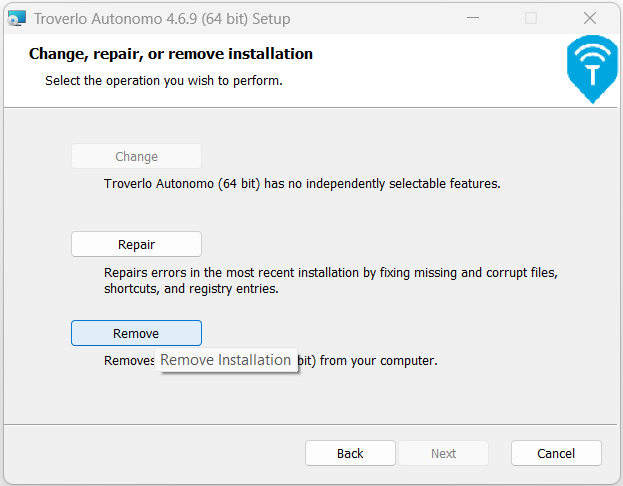
- Select "Remove"
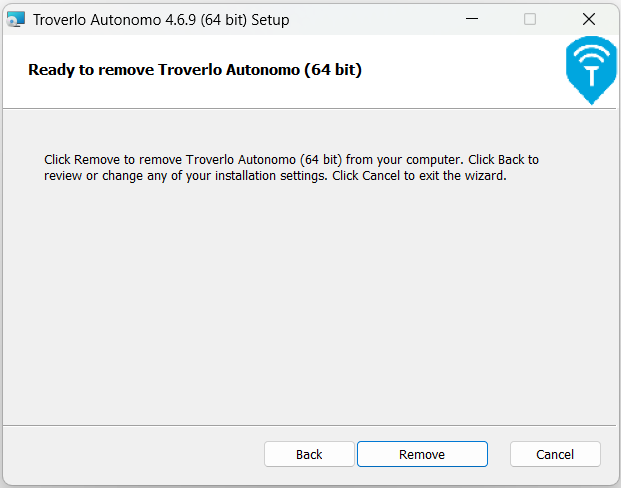
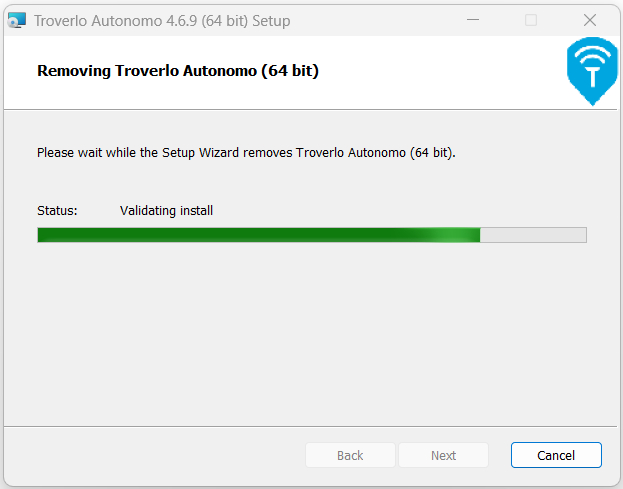
- Select "Remove"
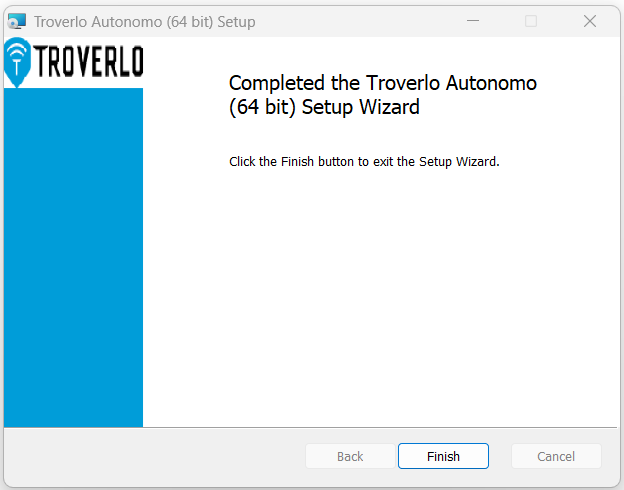
- Select "Finish"
- <x.y.z> is the version number for example TroverloAutonomoV4.3.6.msi.
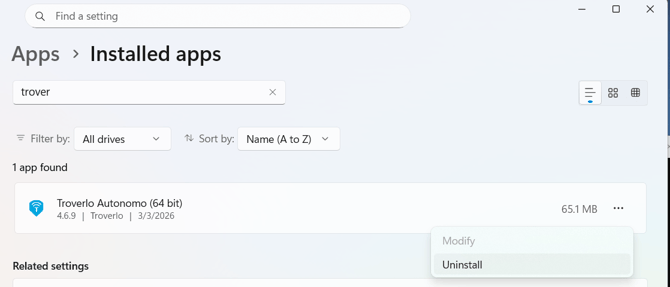
- Add/Remove programs
- Navigate to Apps -> Installed Apps
- Search for "Troverlo"
- Select 3 buttons on the left
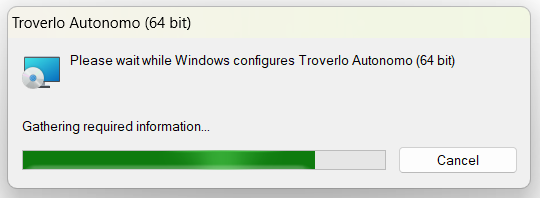
- Select "Uninstall"
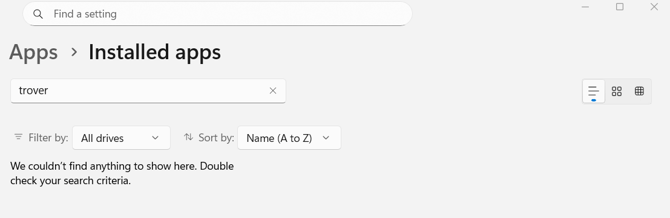
- When complete, it will not show the Troverlo Autonomo any longer.
- Launch TroverloAutonomoV<x.y.z>.msi
- Hint for quiet, UI and Add/remove uninstall
- Stopping the Troverlo Autonomo service in the Windows Service Manager and making sure Event Viewer are closed, ensures the installation happens much faster (30s vs 5-10min)