
Learn more about Autonomo here.
Prerequisites
The user installing the Autonomo application must be assigned as an admin, manager or install role.
Before starting, please review the install check list in the first section.
There are three ways you can install Autonomo:
- Autonomo - Installation via UI
- Autonomo - Installation via command window (quiet) - This document.
- Autonomo - Installation via Intune MDM
Please see the below to find more details when installing Autonomo:
- Autonomo - Asset Category and Asset Sub-Category options
- Autonomo - Asset Groups
- Autonomo - Auto-provisioning
- Autonomo - Install Troubleshooting Guide
Steps for Installing Autonomo on an Asset
- Create an account in the Troverlo Portal if one does not exist for your company.
- Download AutonomoSetup.exe
- This same link can be accessed by selecting the last option on the Navigation panel of the Portal.
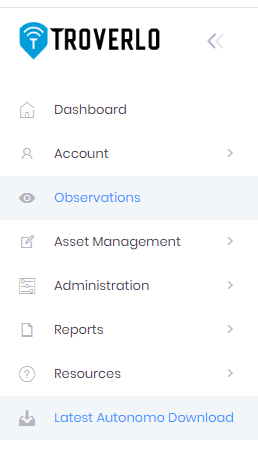
- This same link can be accessed by selecting the last option on the Navigation panel of the Portal.
- lick on the link called AutonomoSetup.intunewin to download the Intune package.
- Or click on this link AutonomoSetup.exeto download the Intune package.
- With most browsers, by default files downladed are put into the \users\<username>\downloads folder.
Quiet install/update/repair of Autonomo
Run this command in an admin command prompt window where the AutonomoSetup.exe file is located to install Autonomo for the first time on this device or to update Autonomo to a newer version.
AutonomoSetup.exe --install USERNAME=“<usernameValue>" PASSWORD=“<passwordValue>" CATEGORY="<categoryValue>" SUBCATEGORY="<subCategoryValue>" ASSETGROUP="<group1,group2,group3>" CURRENTUSER='yes" AUTONOMODE="Active"
Notes:
- Please note: the user that is installing Autonomo must have the "installer" role assigned to them. - see User (Team Member) Management
- Replace the additional text surrounded by "<>" with your data
- Click to learn more about CATEGORY, SUBCATEGORY and ASSETGROUP.
- The double quotes "" are safer, not required. If key entering after the value does not have special characters or spaces, they are not need.
-
ASSETGROUP, CURRENTUSER, AUTONOMODE, LOGFILE are optional parms
- ASSETGROUP,
- This allows you group assets together to aid in searches.
- There can be multiple items, they must be separated with a comma, no spaces.
- AUTONOMODE
These are the Autonomo Modes you can choose from- “Active”
- Autonomo operates as an Observation Endpoint and there is a desire to track this device as an Asset.
- Autonomo will post Wi-Fi scan data for all detected APs and other Troverlo Assets (if any) within an observation window and will include its own ID in the post.
- Can publish or receive Action Commands.
- This is the default.
- “OESR” – Observation Endpoint Self-reporting
- Autonomo operates as an Observation Endpoint and there is a desire to track this device as an Asset.
- Autonomo in this mode will ONLY post Wi-Fi scan data about itself, Assets and APs when other Troverlo Assets are detected within an observation window.
- Never advertises its location – when offline it doesn’t beacon.
- Can publish, but cannot receive Action Commands.
- “OE” – Observation Endpoint
- Autonomo operates as an Observation Endpoint and there is NOT a desire to track this device as an Asset.
- Autonomo in this mode will ONLY post Wi-Fi scan data that contains Troverlo Assets and APs when other Troverlo Assets are detected within an observation window.
- Never advertises its location – when offline it doesn’t beacon.
- Can publish, but cannot receive Action Commands.
- “Active”
- CURRENTUSER
- Autonomo monitors the current account user and transmits this information securely via SSID to the Troverlo platform with each observation for that Asset.
- WARNING: You canNOT use CURRENTUSER="yes" with AUTONOMODE="OE". If both of these are used, an error will be show and you will have to change one to complete the installation.
- LOGFILE
- Designate file name and full path for the installation log file to be used for troubleshooting
- Example usage:
- Designate file name and full path for the installation log file to be used for troubleshooting
- Example usage:
- LOGFILE=C:\windows\temp\autonomoInstaller.log
- Default log filename is AutonomoInstaller.log and it can be found in the \users\<username>\appData\localTemp folder
Quiet uninstall of Autonomo
Run this command in an admin command prompt window where the .msi files is located:
AutonomoSetup.exe --uninstall
The uninstaller will remove all files, folders and logs from the device.
Uninstalling Autonomo requires internet connectivity, as we will change the Asset to be in the Archive state in the Troverlo platform.
Installer log
The default AutonomoSetup.exe log filename is AutonomoInstaller.log and it can be found in the \users\<username>\appData\localTemp folder, if the optional LOGFILE key is not used
These logs file provides information output from the AutonomoSetup.exe when quiet install is used (command line).
Use it to validate:
- The Autonomo version, date and time installed, updated, repaired or uninstalled.
- All the parameters entered on the command line.
Use it to troubleshoot
- It will show all the steps covered.
- It will show success or any errors if not successful.
Troubleshooting if you have problems installing Autonomo
Please reference the Autonomo - Install Troubleshooting Guide if you encounter issues not addressed above or you may contact Troverlo Support via our Support Center.